Common issues with Hospitality EPOS systems
A hospitality EPOS system is one of the most business-critical systems you rely on in your venue. Any outages or issues can disrupt service and lead to unhappy customers.
Many providers are quick to point out their great features and support, but are less forthcoming about the issues their customers face.
In this article, we address this gap and look at some of the common issues with hospitality EPOS systems and how you can minimise or mitigate them.
Network
A poor or unreliable network can cause issues for any cloud-based EPOS system. If you run a small venue, a standard internet router with Wifi may be adequate.
If you have a large venue, particularly one that gets busy, investing in a good network of wireless access points will be one of the best investments you can make.
If you have a really poor network and are unable to address it, it might be worth considering standalone EPOS terminals with built-in servers. These tend to be older systems that might lack modern features and are rarely upgraded, but if you really need something that will work reliably on a very poor network, this could still be an option to consider.
A cloud EPOS can have functions to help with network outages, such as an offline mode. Even with the best network, outages are possible, so it’s always worth checking that there is an offline mode and any limitations.
A good offline mode is great for handling unforeseen outages, but we wouldn’t recommend relying on it for day-to-day trade to compensate for an inadequate network. It is better to invest in your network or look for a standalone EPOS terminal.

Hardware
The main item of hardware most bars deal with is a printer, and there is always a possibility that any hardware can go wrong. Whether it’s a manufacturer fault, a drink spilt over it, or just bad luck (a paper jam), issues do happen and can impact service when they do.
To minimise hardware issues, ask your provider about the printers (and any other hardware) they recommend with their system. If you can purchase the hardware from them, check the warranty period offered.
Ensure your printers are set up correctly, including being allocated static IP addresses (this should be done on your router – refer to the manual for your model). Doing so avoids the need to reconnect your POS to a printer in the event of a power failure or a printer reboot.
Ask if there are alternatives to printing – emailing of receipts, order screens for order tickets, which can be used in the event of issue, or even as part of your default operation. Order and
kitchen screens offer many other advantages, including tracking service times, order status messaging, and even helping reduce your carbon footprint.
Training or usability issues
Many support requests raised to our team come down to questions about how to perform certain functions, or issues resulting from not realising the best way to do something or set something up.
Every feature of our hospitality EPOS system is designed with usability in mind, and front-of-house staff can usually get up and running very quickly with minimal training. However, with any feature-rich system, there will be areas that benefit from some up-front training, reading of the knowledge base, or just asking questions.
Take advantage of any training offered by your provider. We often find that an initial demo is useful for evaluating a system, but booking in a training session after you have had a chance to use the system is invaluable. At this point, you have tried out the actions you need to perform in your role in the business and can come armed with any questions or issues you have encountered.
Our onboarding team have a wealth of hospitality experience and will take the time to understand what you want from the system and ensure you’re fully up and running with everything you need. Additional ad hoc training is included with every EPOS plan once you're up and running, should you want to take advantage of extra features or need a refresher on how particular areas work.
If you don’t have time to book a training session, or you just have a few questions, check the knowledge base, or ask the support team you have available. It is much better to ask a question before you start doing something than try to unravel it later from doing something wrong. Once you start doing something one way, you may never ask about it or realise there is a much better way to do it.
Check with any provider how accessible their support team is. If you need to send an email, wait on a phone line or fill in a form, the chances are your staff will stumble through doing things the way they have worked out instead of asking about the best way.
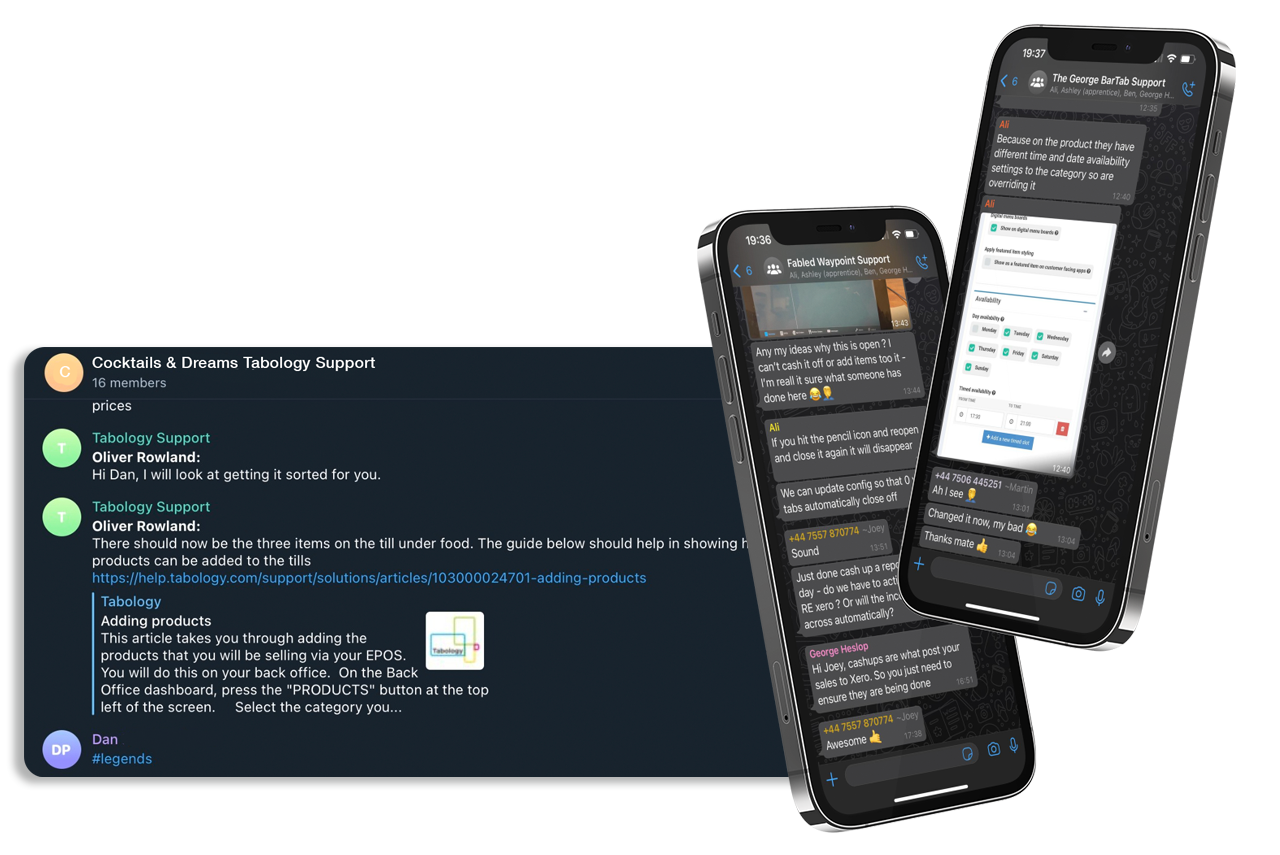
We provide an instant messaging channel for every venue where staff can ask questions and get responses in minutes, without having to wait on the line. These channels are monitored by our team 8am – midnight seven days a week.
Integration issues
With technology now a key part of hospitality operations, you can rely on an increasingly complex stack of platforms beyond your EPOS. Booking systems, payment providers, accounting software, delivery aggregators, loyalty programmes, and stock control tools, to name a few. While many of these platforms claim to integrate with each other, integration failures have become one of the most common and frustrating POS system issues operators face.
The problem typically falls into one of three categories: integrations that were never set up correctly, integrations that break when one platform updates, and integrations that technically function but don't exchange the data you actually need.
A booking platform that doesn't pass covers to the EPOS, a delivery aggregator that creates duplicate items, or accounting software that pulls incomplete sales data can all create significant operational headaches.
When evaluating a provider, don't just ask which integrations are available – ask how they're maintained. Are they built directly with the partner platform, or are they reliant on a third-party connector? What happens when one side of the integration updates? Is there a support process specifically for integration issues?
One way to minimise integration problems is to choose a hospitality EPOS that offers as many built-in tools and functions as possible, thereby avoiding a raft of 3rd-party integrations that are vulnerable to issues. That way, data is in one place and flows seamlessly, staff only have to navigate one platform, and any issues or bugs are resolved much faster as there is only one possible source to investigate.
Software bugs
Many providers may understandably shy away from discussing software bugs, but even with the most reliable software, some bugs will creep in. A good provider recognises this and takes action to minimise bugs and make it as easy as possible for customers to raise them so they can be fixed.
Ask your potential provider about their testing of new releases, and see how they answer this question and how much detail they can provide. Ask about any recent issues and what has been done to stop them from happening again.
A good process of continuous improvement in detecting issues, identifying causes, and preventing recurrence is the core foundation for minimising software bugs. If a supplier can give you a good answer about how they do this, it should give you some confidence.
If you're interested in finding out more about our hospitality EPOS system, and how it could work in your business get in touch with our team.